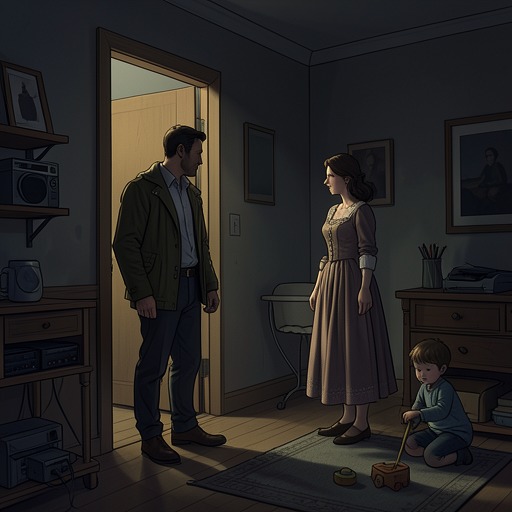
Grace McCall
I'm Still Here- What didn't kill me made me stronger and sharperGrace McCall is the nurse who turns Jensen Brick McCall’s failed abortion and abandonment into a life that can continue. After discovering that the newborn is alive, she tries to return him to his birth mother, but when the mother refuses him, Grace chooses to protect him, names him Jensen Brick McCall, and gives him a home. Her rescue makes her the decisive counterforce to the maternal rejection that shapes Jensen’s identity, while her later addiction and guilt show that care can preserve a life without remaining untouched by the violence surrounding it.
Identity and the Rescue of Jensen
Grace first appears through her work as a nurse and her immediate recognition of the newborn’s precarious situation. She calls Jensen’s birth mother and identifies herself as the nurse who helped her that day, explaining that the baby is alive, breathing, healthy, and weighs five pounds, ten ounces. Grace offers to bring him to her rather than conceal what happened, treating the infant as a person whose survival creates an obligation.
The mother’s refusal changes Grace’s role from medical intermediary to protector. Grace offers practical help with money, housing, welfare, Catholic Charities, formula, clothes, and a crib, but the mother still tells her to let the baby die and insists that she had no baby. Grace then rocks the infant as tears fall onto his face. When he smiles and grips her thumb, the abandoned child becomes, for her, a living claim that cannot be ignored. She decides that she cannot watch him take his last breath and interprets his survival as a sign that God has chosen him to live.
Grace takes the child home, promises that he has a purpose, and names him Jensen Brick McCall. She also creates his birth certificate, just as she had created a death certificate, replacing the administrative possibility of death with an official identity and a future. The contrast is central to her character: Grace does not merely comfort Jensen; she materially constructs the conditions under which he can exist.
Motherhood, Race, and Domestic Conflict
Grace becomes Jensen’s mother in practice, although she refuses to let him call her Mom because she believes that title belongs to his birth mother. This restriction leaves their bond both intimate and qualified. Jensen remembers Grace as a small, gray-haired woman devoted to gardens and baking cookies, a domestic presence whose ordinary routines stand against the extraordinary circumstances of his birth.
Her household is also marked by racial hostility. Her husband, Rick, calls Jensen a racial slur, but Grace insists that his name is Jensen and refuses to let that insult replace his identity. She endures Rick’s abuse on Jensen’s behalf, and he eventually leaves because he considers it an embarrassment that she chose the child over him. Grace’s protection therefore carries a cost: she secures Jensen’s place in the household by sacrificing marital security and accepting sustained conflict.
Jensen’s memories of Grace’s care include reading and education. She taught him to read, took him to the library every Saturday, and reminded him that education could save his life. The library becomes one of the places where he remains alive and out of jail, so Grace’s teaching operates beyond childhood instruction. It becomes part of the survival system through which Jensen later understands his own trajectory.
Addiction, Guilt, and the Reversal of Care
Grace’s decline begins after Rick leaves. She spends more time in her room, repeatedly goes to the pharmacy, takes ten pills with a glass of wine at breakfast, and becomes addicted to Vicodin and Percocet. Jensen finds her passed out on the couch and, at nine years old, begins caring for her by giving her tea and toast. After she loses her hospital job, her self-destruction continues through smoking water and a cigarette dipped in embalming fluid. When Jensen asks why, she explains that she wants to forget her wrongdoings.
The later explanation makes her addiction inseparable from her medical past. Grace is haunted by the babies she helped kill, by their crying, and by the repeated image of rows of infants watching their last breaths. She had tried to call mothers who had ordered that their children be allowed to die, but she saved only Jensen. Her guilt is therefore not presented as a vague private sadness; it is attached to repeated deaths, failed attempts at repair, and the singular exception of Jensen’s survival.
This history reverses the original rescue. Grace once lifted Jensen from a room where he had been left to die; later, Jensen feeds and tends to Grace when addiction makes her unable to care for herself. The relationship becomes an unpaid exchange of bodily and emotional labor, but not a simple repayment of debt. Jensen’s childhood care demonstrates both his attachment to Grace and the burden placed on him by her collapse.
Jensen’s Wound and Grace’s Continuing Presence
Jensen calls his birth mother his murderer because she attempted to abort him at twenty-six weeks, rejected him after the procedure failed, and left him in darkness to die. He distinguishes this figure from Grace, the nurse who first cared for him and saved his life, yet Grace remains central to the wound because she is the person who knows exactly how close he came to death. Her rescue gives him life, while her account of that rescue gives him the language through which he interprets it.
Grace repeatedly tells him that babies do not normally survive a botched abortion and that he has no cerebral palsy, seizures, or other expected consequences. She tells him that God chose him and that he is destined to do something great. These assurances become a spiritual framework for Jensen’s later self-understanding: he sees himself not as a dead man walking, but as someone assigned a mission. Grace’s words transform biological survival into purpose, even as the pressure to fulfill that purpose can also make his life feel like an obligation imposed from outside.
When Jensen returns to the house that was once his home, its fallen shingles, chipped pale-blue paint, and broken windows contrast with the persistence of Grace’s memory. He recalls that she said God summoned her to him, that he grabbed her fingertip, and that his eyes were wide open like silver dollars while eleven other babies on the same table were dead. The ruined house thus becomes a material record of loss and a remaining witness to Grace’s choice.
Narrative Role and Significance
Grace is the novel’s clearest embodiment of care as action rather than sentiment. She calls the birth mother, offers resources, rocks the child, creates his legal identity, defends his name, teaches him to read, and accepts the consequences of choosing him. Her care is concrete, repetitive, and often costly. It is also imperfect: she cannot erase Jensen’s abandonment, prevent the later damage caused by addiction, or free him from the question of why he survived.
Her character complicates the novel’s language of murder and salvation. Jensen’s birth mother is named as his murderer, but Grace’s history includes participation in abortions that left her haunted by the children she did not save. She is therefore neither an uncomplicated saint nor merely a guilty medical worker. She is a person who has caused or witnessed death, made one decisive exception, and spent the remainder of her life trying to live beside that exception. Jensen’s survival becomes both her proof of grace and the source of a guilt she cannot resolve.
Grace’s importance reaches beyond Jensen’s childhood. In a story where abandonment repeatedly returns through lost parents, dead friends, addiction, self-harm, and threatened relationships, she provides the first example of an attachment that says a life can be chosen after it has been rejected. Jensen later describes himself as having found his murderer and, more importantly, found himself. Grace makes that second discovery possible: she preserves the body, supplies the name, and leaves him with the belief that survival can become a mission rather than merely an accident.